Posts

So, what is PDA anyway?

Image
   Both a type of avoidance & a neurotype (Originally published on the PDA Insiders website )  PDA—Pathological Demand Avoidance—can be confusing because the same term is used to describe both a pattern of avoidance and a full neurotype (brain type). The neurotype involves many more traits than demand avoidance alone, which is why misunderstandings often arise. Because PDA is the name of a neurotype, people sometimes use the acronym as a noun (pronounced “pee-dee-ay”) or as an adjective, much like “autistic.” For instance, someone might describe themselves as a “PDA person.” Isn't "pathological" a dirty word? While some people dislike the term because “pathological” is traditionally linked to illness, many PDA individuals feel it best captures the intensity and involuntary nature of their avoidance. Much like the disability community reclaimed the term “disabled,” some PDA pe...
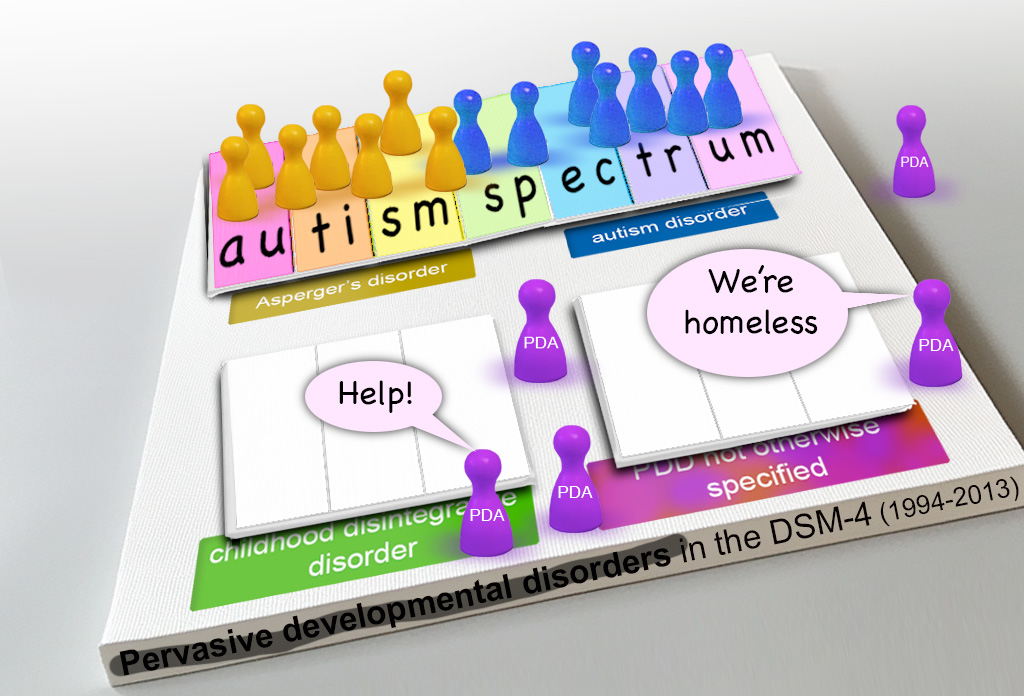
Is PDA Autism? Rethinking Diagnostic Boundaries in the Neurodivergent Landscape

Image
By PDA Insiders (Sally Cat and Brook Madera), plus guest quotes Illustrated by Sally Cat Introduction Pathological Demand Avoidance (PDA) remains one of the most contentious and confusing neurodivergent profiles. At the heart of this debate is one persistent question: should PDA be recognised as a subtype of autism—or does it demand a category of its own? To understand this, we need to trace the evolution of diagnostic systems and how PDA people became diagnostic refugees. From PDD to the Autism Spectrum: The Collapse of Diagnostic Diversity Under the DSM-IV, conditions such as autistic disorder, Asperger's syndrome, and pervasive developmental disorder not otherwise specified (PDD-NOS) existed as separate but related diagnoses.  PDA was first noted, and named by, Professor Elizabeth Newson who identified the profile in children referred to her during the 1980s who puzzled clinicians by seeming autistic in someways, but with marked differences. This classed PDA as slotting under t...